What Is a Metering Pump and How Does It Work?
Metering pumps are used wherever a chemical has to be added in an exact quantity: chlorine into drinking water, antiscalant into an RO plant, corrosion inhibitor into a pipeline or phosphate into a boiler. This guide explains how they work, the main types and how to pick one.
Not sure which metering pump you need? Send us your chemical, flow and pressure.
How a metering pump works
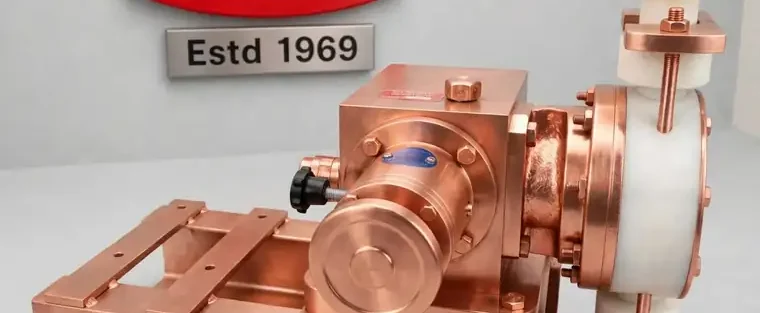
An electric motor turns a worm gearbox, which converts rotation into a short back-and-forth stroke. On the suction stroke the plunger or diaphragm pulls back, the suction check valve opens and chemical is drawn in. On the discharge stroke it moves forward, the suction valve closes, the discharge valve opens and that exact volume is pushed into the line.
Flow is set in two ways: stroke length (how far the plunger or diaphragm travels, adjusted by a knob from 0–100%) and stroke rate (strokes per minute, changed with a VFD on the motor). Flow = volume per stroke × strokes per minute.
Main types of metering pump
| Type | How it moves the liquid | Best for |
|---|---|---|
| Plunger (piston) | Plunger in direct contact with the liquid, sealed by packing | High pressure, clean liquids, large flows |
| Mechanical diaphragm | Diaphragm linked directly to the drive | Leak-free dosing at low to medium pressure |
| Hydraulic diaphragm | Plunger pushes oil, oil flexes the diaphragm | Leak-free dosing at higher pressure |
| Solenoid | Electromagnet pulses a small diaphragm | Very small flows, light duty |
For a detailed comparison read plunger vs diaphragm metering pump and motor-driven vs solenoid dosing pump.
Main parts
- Drive: motor, worm gearbox and stroke adjustment.
- Liquid end: pump head, check valves (balls and seats), and plunger or diaphragm. Its material must suit the chemical; see our chemical compatibility chart.
- Accessories: pressure relief valve, back pressure valve, calibration column, pulsation damper and strainer.
Where metering pumps are used
Water and wastewater treatment, chemical and pharma plants, refineries and oil and gas, fertilizer, sugar mills and distilleries, paper mills, boilers and cooling towers. See industries we serve.
How to choose one
- Work out the chemical flow you need. Our dosing pump calculator does this from flow, ppm and chemical strength.
- Note the discharge pressure at the injection point.
- Pick plunger for high pressure, diaphragm for toxic or leak-sensitive chemicals.
- Choose liquid end materials for the chemical and temperature.
- Add a relief valve and, if the line pressure is low, a back pressure valve.
Frequently asked questions
Is a metering pump the same as a dosing pump?
Yes. Both names describe a positive displacement pump that adds a measured amount of chemical. “Metering” stresses accuracy; “dosing” stresses the application.
How accurate is a metering pump?
Good motor-driven metering pumps repeat within about ±1% at a fixed setting. Accuracy is best between roughly 10% and 100% of stroke length.
What pressure can a metering pump handle?
Mechanical diaphragm pumps typically work up to about 10–20 bar; plunger pumps can be built for much higher pressures. Tell us your pressure and we will recommend the right type.
Get a metering pump sized and quoted by our engineers.
Jagdish Engineering Works, Mumbai – manufacturer of plunger and diaphragm metering pumps and pressure relief valves since 1969. Our engineers design, test and repair dosing pumps for water treatment, chemical, refinery, fertilizer, sugar and paper plants.
About JEW · Engineering resources · Ask an engineer on WhatsApp